

Not every child learns the same way. But if you have noticed your little one picking up a pencil, asking big questions, or getting restless with screen time, it might be time. Here is how to tell, and what to look for in a book that keeps them genuinely engaged.
Sign 01
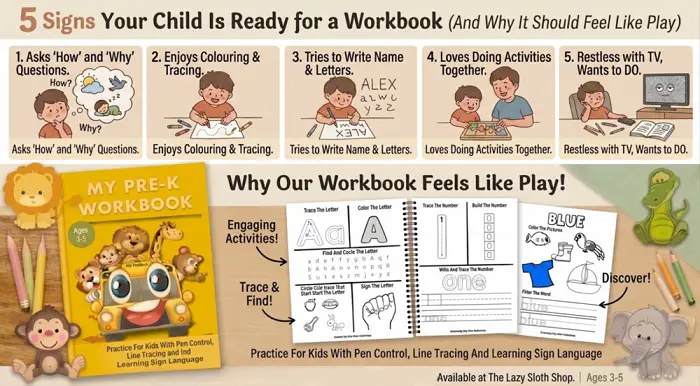
They ask "how" and "why" questions constantly
You know the phase. Every answer you give leads to another question. Why is the sky blue? How do birds know where to fly? Why do we sleep? If your child's curiosity has shifted into overdrive, that is not just adorable, it is a developmental green light. Their brain is actively reaching for information and making connections. A well-designed workbook meets that curiosity with gentle, guided discovery, giving them a space to explore answers at their own pace.
Sign 02
They enjoy colouring, drawing, or tracing
When a child chooses to sit down with crayons or markers on their own, they are building fine motor skills, concentration, and hand-eye coordination without even knowing it. Drawing and tracing are the foundations of writing. If your child gravitates toward creative mark-making, a workbook with colouring activities and tracing exercises will feel like a natural extension of something they already love, not a task they have been given.
Sign 03
They try to write their own name or copy letters
This one is a big signal. When a child starts attempting letters, even wobbly ones, they are showing both the motivation and the readiness to begin structured practice. They are not just scribbling; they are trying to communicate something on paper. That instinct deserves to be nurtured, not rushed. A good preschool workbook channels that energy with letter-focused activities that build confidence alongside skill.
Sign 04
They love sitting with you doing activities
Some children are natural solo players. Others light up when a grown-up is right there with them. If your child frequently brings you puzzles, books, or crafts and asks you to do them together, a workbook becomes a beautiful shared ritual. Side-by-side learning is powerful. It builds connection, models patience, and makes the whole experience feel safe and special rather than like schoolwork.
Sign 05
They get frustrated with TV and want something to do
Passive screen time stops satisfying some children earlier than you might expect. When your child starts pushing back on television, flicking through it without settling, or wandering off to find something more engaging, pay attention. That restlessness is their brain asking for something with more input. A hands-on workbook gives them agency, a sense of accomplishment, and something they can actually do.
What makes a good preschool workbook
Not all workbooks are created equal. Some feel like miniature exams, full of pressure, red boxes, and right-or-wrong formatting that can knock a young child's confidence before it has even had a chance to grow. That is the last thing we want.
A truly good preschool workbook is built around one idea: guided play. Here is what that looks like in practice:
The goal is not to produce a child who can read at three. The goal is to build a child who associates learning with joy, curiosity, and calm focus. Those habits will carry them further than any early academic milestone.
Get the workbook
Our Preschool Activity Workbook
Designed for ages 3 to 5. No pressure, no timers. Just gentle, playful activities your child will actually want to sit with. Instant download available.